



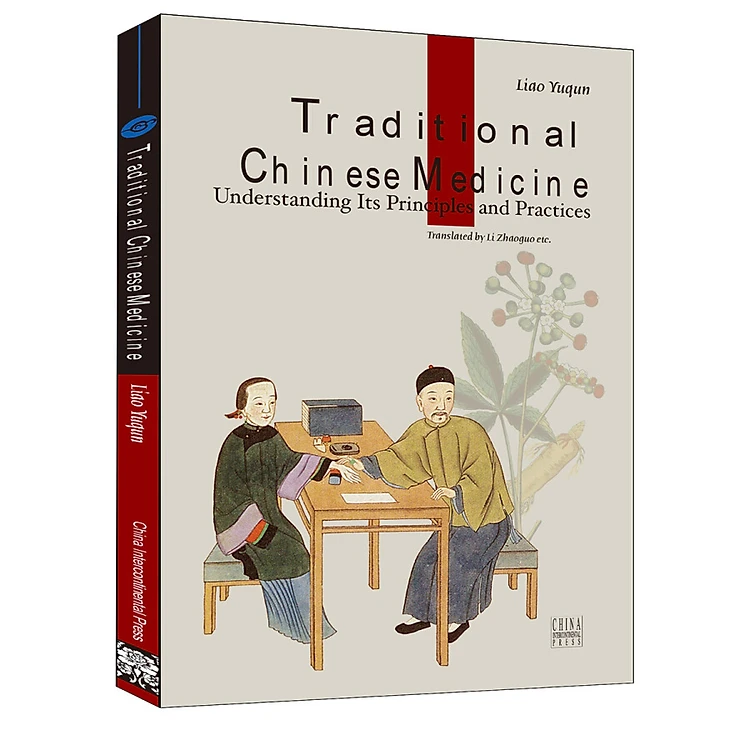
Traditional Chinese Medicine
327.600
Sản phẩm đã hết hàng
Bạn có thể xem các sản phẩm tương tự.Mô tả sản phẩm
Main Content
Traditional Chinese medicine and pharmacology is arousingincreasing attention from around the world. In the form of telling stories,this book narrates the origin of Chinese medicine, and summarizes its basictheory and its root in traditional Chinese philosophy. It tells stories ofoutstanding physicians and pharmaceutists in Chinese history, and gives briefintroductions to its unique diagnostic and therapeutic methods, such assphygmology, acupuncture and moxibustion, and phytotherapy; the mutualinfluence between Chinese medicine and Indian medicine, and between Chinesemedicine and Arabic medicine; the history of traditional Chinese medicineintroduced into Japan and Korea; and its positive influence on modern healthconcept.
Catalog
Contents
Foreword 1
Approach to Traditional Chinese Medicine 3
Recognition of TCM 4
The Thinking Style of TCM 7
The Formation and Variation of Tradition 12
Understanding TCM 17
The Classics of TCM 21
Huang Di Nei Jing (Yellow Emperor’s Canon of Medicine) 23
Huang Di Ba Shi Yi Nan Jing (Yellow Emperor’s Canon On Eighty-One Difficult Issues) 24
Shen Nong Ben Cao Jing (Agriculture God’s Canon of Materia Medica) 26
Shang Han Za Bing Lun (Treatise on Cold Diseases and Miscellaneous Diseases) 27
Compilation of Book and Development into Canon 29
Basic Theory of TCM 33
The Theories of Yin-Yang and Wu Xing 34
Viscera and Their Manifestations 40
Channels and Collaterals 43
Etiology 49
Diagnostics 53
Internal and External Therapies of TCM 59
Acupuncture and Moxibustion 60
Prescriptions 64
Treatment of Both the Internal and the External 70
Knowledge of Materia Medica 73
Establishment of the Theory of Materia Medica 74
Important Books on Materia Medica 75
Pharmacological Studies 81
Drug Administration and Market 82
Processing of Herbs 86
Story about Ginseng 88
Stories about Famous Doctors in History 93
Bian Que 94
Zhang Zhongjing and Hua Tuo 95
Wang Shuhe and Huang Fumi 98
Sun Simiao 100
The Four Great Schools in the Jin and Yuan Dynasties 101
Zhang Jingyue 104
Ye Tianshi 105
Wang Qingren 108
TCM and Life Cultivation 111
Life Cultivation in the Four Seasons 112
Integration of Food and Medicines 115
Sports and Health 118
Emotions and Diseases 120
Inheritance and Development of Modern TCM 123
To Establish a Standard System for TCM 124
Development and Innovation of TCM in Clinical Use 126
To Integrate TCM with Western Medicine and Encourage the Modernization of TCM 128
TCM Going to the World 130
Appendix: Chronological Table of the Chinese Dynasties 132
Digest
TCM and Life Cultivation
The aim of medicine is to keep health and it is also the aim of life cultivation. Though science of life cultivation is closely related to medicine, it is not included in the system of medicine. For instance, qigong is a sort of exercise for life cultivation, but most TCM practitioners are unfamiliar with such a therapy or do not use such a therapy to treat patients. It seems that qigong is a separate system of therapeutics.
Chinese jujube and haw are traditionally used by women after delivery of child for nourishing and activating blood. However most TCM doctors do know the decoction composed of jujube and haw known as er hong tang (Double Red Decoction). The authentic way to treat women just after delivery of child is to use sheng hua tang (Production and Transformation Decoction), composed of dang gui (Radix Angelicae Sinensis), chuan xiong (Rhizoma Chuanxiong), tao ren (Semen Persicae) and pao jiang (Rhizoma Zingiberis Preparata), for activating blood to resolve stagnation.
Life Cultivation in the Four Seasons
To cultivate life in the four seasons is an important principle in TCM. In Huang Di Nei Jing (Yellow Emperor’s Canon of Medicine), it says “sages cultivate their life by following the climatic changes in the four seasons and that is why they can avoid attack by pathogenic factors and live a long life.”
The reason that TCM emphasizes the importance to cultivate life in accordance with the four seasons is that it advocates the theory of maintaining a unity between the heaven and human beings. TCM believes that the natural world is a big universe while the human body is a small universe. In Huang Di Nei Jing (Yellow Emperor’s Canon of Medicine), it says that the changes of yin and yang in the four seasons are key to the growth of all things. So cultivation of health or life has to abide by the principle of invigorating yin in the spring and summer while nourishing yin in autumn and winter.
The following are the quotations from Huang Di Nei Jing (Yellow Emperor’s Canon of Medicine) about how to cultivate life in the four seasons.
In the three months of spring, all things on the earth begin to grow. The natural world is resuscitating and all things are flourishing. People may sleep late in the night and get up early in the morning, taking a walk in the courtyard with hair running free to relax the body and enliven the mind. Such a natural resuscitating process should be activated instead of being depressed, promoted instead of being deprived and encouraged instead of being destroyed. This is what adaptation to chun qi (spring-qi) means and this is the dao (principle) for cultivation of health. Any violation of this rule may impair the liver and result in cold diseases in summer due to insufficient supply for growth in summer.
Preface
Foreword
In ancient China, four well-developed areas in the civilization were astronomy, arithmetic, agronomy and traditional Chinese medicine (TCM). They were generally accepted as systems of knowledge and techniques with Chinese traditional colors, despite the fact that some people denied they were “sciences.” In modern China, TCM is the only surviving subject among those four that hasn’t been replaced by Western science, and it still plays a significant role in most Chinese people’s life.
Since it was established at a time without the support of advanced science, how can TCM survive in today’s society when modern health care is almost able to cover all the medical needs? Is TCM a science or cumulative experiences? Is it able to go further along its own path of development, or is it meant to be replaced by mainstream Western medicine? Questions like these concern many people.
In most people’s eyes, TCM is a medicinal system that dates back several thousand years, and its theories, experiences and techniques are all derived from the same origin—“tradition.” However, when Western medicine is spreading across the country, its new system, which is greatly contradictory to that of TCM, takes turns to dominate the academy. It was known as a “revolution” in Chinese medical community. If fact, if we pay close attention, we will find a revolution in the history of TCM itself. After many big and small revolutions, today’s Chinese medicine has become “contemporary TCM,” which greatly differs from TCM in ancient times. So sharing a same region does not exclude changes.
Traditional medicine in China did not go through big setbacks compared to traditional medicine in other countries. It has always continued in social life and in the career of health care. Some say TCM is right alongside Western medicine, and many scholars from both home and abroad believe the reason is that Western medicine has still not become fully popular. So TCM is needed as a complimentary part of medicine, especially in rural areas. However, the most popular places for TCM are not in the most developed big cities. Correspondingly, many people in the countryside hope to get modern treatments when they are sick. In big cities, people are afraid of infections from medical examinations, as well as the potentially toxic side effects from chemicals and drugs, and many do not accept surgeries easily. They prefer to seek alternatives in TCM, in hopes of a more “natural” treatment. Such concern is growing day by day. This phenomenon might be seen as the “renaissance” of the traditional medicine in China in our contemporary age. Out of such needs, we can foresee that TCM will not die against the threat of Western medicine, but will continue to exist in its own special role.
Illustration
Giá sản phẩm trên Tiki đã bao gồm thuế theo luật hiện hành. Bên cạnh đó, tuỳ vào loại sản phẩm, hình thức và địa chỉ giao hàng mà có thể phát sinh thêm chi phí khác như phí vận chuyển, phụ phí hàng cồng kềnh, thuế nhập khẩu (đối với đơn hàng giao từ nước ngoài có giá trị trên 1 triệu đồng).....